
Great Places to Live Make Great Places to Visit

A love letter to Halifax, with a few honest notes in the margins.
I've lived in Halifax for just over four years, which makes me a come-from-away. But my heart chose this city long before my mailing address did.
In 2009, my partner's job moved us from Toronto to Moncton for a short stint. Moncton was lovely, but Halifax kept pulling at us. We spent weekend after weekend driving down to wander the waterfront and the North End. Coming from Toronto, it felt a little magical. Halifax was small enough to feel human and big enough to feel alive. I knew I'd make my way back one day. I had to.
Near the end of the pandemic lockdown years, we finally did it. We followed a trail of Bluenose dimes east, brought the whole family with us, and haven't looked back.
It's the best place I've lived in Canada. As someone who works in sustainable tourism, I've spent a lot of time thinking about why. The answer keeps coming back to an idea tourism leaders around the world have championed for years: great places to live make great places to visit.
An idea the tourism world keeps coming back to
I'm far from the first person to say it. In late 2024, Peter Semone, chair of the Pacific Asia Travel Association, gave a keynote with nearly that exact title. His point was simple. Get a place right for the people who live there, and it naturally becomes a great place to visit.
Copenhagen is probably the best-known city to build a strategy around this idea. In 2017, its destination organization, Wonderful Copenhagen, launched a plan boldly titled The End of Tourism as We Know It. Instead of glossy campaigns, it centred on "localhood." Travellers are treated as temporary locals, and residents and visitors shape the city together, making it a better place to live for everyone. One line from that strategy has stayed with me: visitor growth is not a goal in itself. In 2024, the city went further with Copenhagen, All Inclusive. The new plan also counts tourism's costs, like pressure on local communities and transport emissions, instead of only celebrating arrivals and revenue.
This idea also includes a warning. In 1975, tourism researcher George Doxey described how residents' attitudes toward tourism can slide through four stages: euphoria, apathy, irritation, and finally antagonism. It starts with a warm welcome. If tourism outpaces what a community can absorb, it can end in resentment. We've watched versions of that arc play out in some of the world's most-loved cities.
For a city whose reputation is built on hospitality, that should give us pause. Our warmth is our greatest tourism asset, and also our most fragile one. It lasts only as long as the people who live here feel tourism is working for them too.

A city built on welcome
Halifax's story is an immigration story, and in a small way it's mine too. In the 1930s, my grandmother arrived in Canada through Pier 21. If that moment hadn't happened, I wouldn't be here. Today Pier 21 is the Canadian Museum of Immigration, and the city still welcomes newcomers from around the world.
That story runs much deeper. Long before Halifax had its name, this place was K'jipuktuk, "Great Harbour" in the Mi'kmaw language, and the Mi'kmaq have been its stewards for thousands of years. The city's identity has also been shaped by Acadian heritage, by African Nova Scotian communities with roots going back centuries, and by generations of newcomers from around the globe. You can feel those layers across the city, in its museums, public art, place names and gathering spaces.
That welcome extends to who you are, too. Halifax is proudly diverse and inclusive. In the 2021 census, Nova Scotia had the highest proportion of transgender and non-binary people of any province, and Halifax ranked as the second-most gender-diverse city in the country, just behind Victoria. People here are free to be themselves, and it shows.
All of this explains a lot. Halifax is known around the world for its warmth and hospitality, and it's the real thing, not a line in a marketing campaign. Residents get it at the corner store and visitors get it on the ferry. Hospitality you can't switch off tends to be the kind that lasts.
Liveability is infrastructure
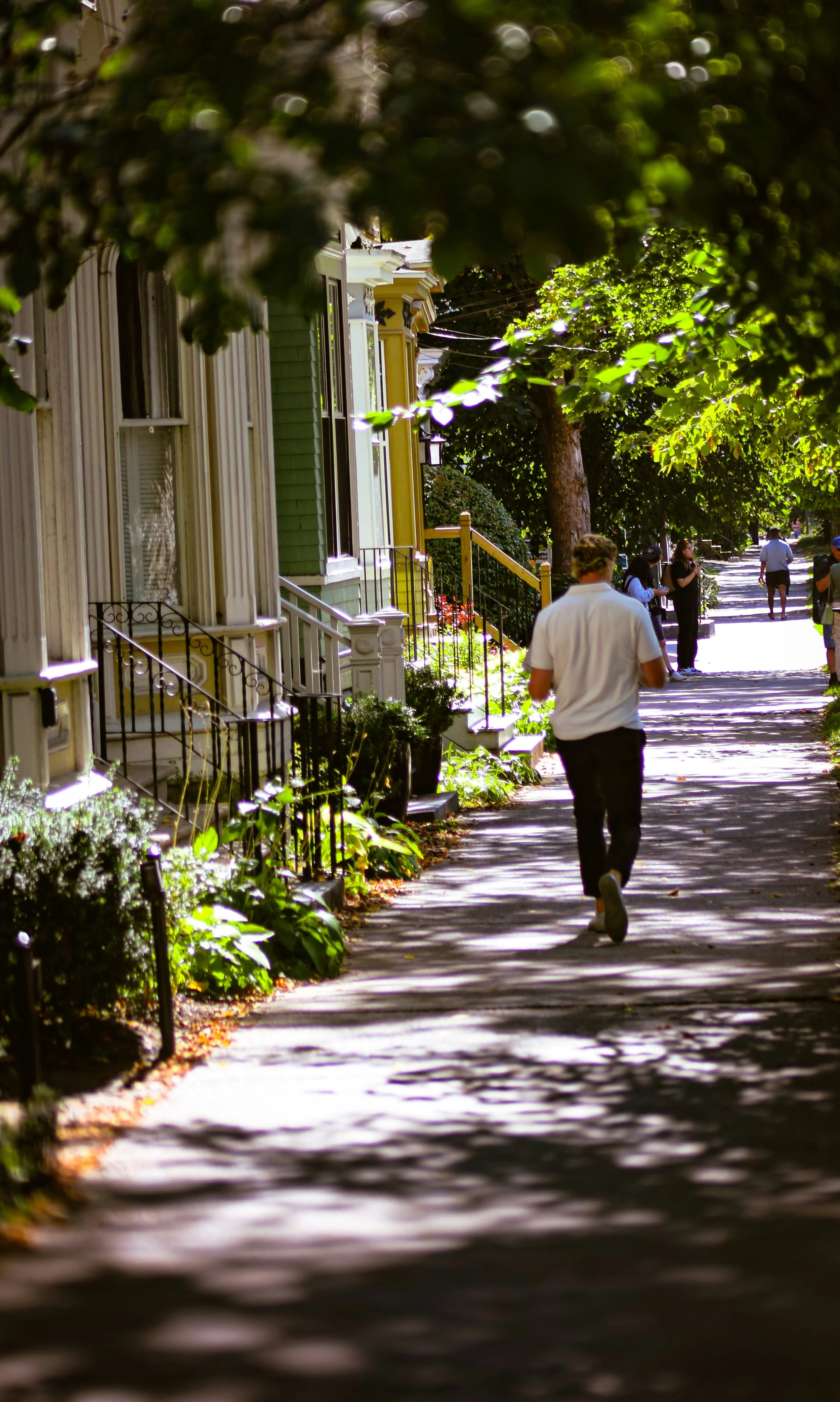
Halifax feels alive all year. Part of that is its human, walkable scale. The city’s core is a peninsula which naturally prevents traditional sprawl — a blessing and a curse. The bigger part is a long-term commitment to shared spaces and public services, the kind of infrastructure that makes a city easy to love.
Leisure without barriers. We have beautiful beaches and outdoor pools with lifeguards on duty. The pools are free or very low cost, so a summer afternoon doesn't depend on your budget. Indoor pools operate year-round.
The Commons. The Halifax Commons is busy from morning until dusk: baseball and cricket fields, tennis and pickleball courts, a huge playground, and the Emera Oval, which lends out free equipment for skating in winter and rolling in summer. Families and people of every age are out moving together all year, right at the foot of Citadel Hill.
Citadel Hill. It's a national historic site, and it's also the best lounging hill (we like to get a pizza and have impromptu picnics there) and sunset spot in the city. Depending on the weekend, it could be hosting a kite festival or a concert.
The waterfront. At roughly four kilometres, our harbourfront boardwalk is one of the longest urban boardwalks in the world. It's as lively as the Commons, lined with cafés, restaurants, public art and benches for watching the working port go by.
History you can feel. Halifax is one of Canada's oldest cities. You can see it in the architecture and in how carefully the city honours and protects its past.
A library that's really a living room. The award-winning Halifax Central Library looks like a stack of books placed at the edge of the historic Schmidtville neighbourhood. Inside you'll find books, maker spaces, events and concerts. It's a true community hub.
The ferry. For $3, the Halifax–Dartmouth ferry is the nicest commute I've had anywhere, and the best seat for taking in the skyline. On the other side, downtown Dartmouth has its own charming main street, food scene, library and markets.
Kids who can get around on their own. My kids travel around the city by themselves on free transit passes. Every public school in the province now offers a pay-what-you-can lunch program, so no child has to learn on an empty stomach.
Local first. Local businesses outnumber chains here, and you notice it. We love our coffee shops, restaurants, bookshops and gift shops. The streets feel personal, not corporate.
Learning everywhere. From Dalhousie to NSCC, the city is full of academic institutions, bringing a steady energy of curiosity and new ideas.
Nature in minutes. You can be on a wooded or coastal trail in minutes. Few cities this size can say that.
A waste pioneer. Nova Scotia banned organics from landfills back in 1998, and Halifax has had curbside green cart composting since 1999. That made it an early leader in North America, and our diversion rates remain among the best in the country.
None of this happened by accident. These are choices made and sustained over decades: investing in places and programs that belong to everyone. Notice that not one item on this list is a tourism product. Every one of them is something visitors love anyway.
Every living system has its struggles
I love this city, and loving a place honestly means naming its problems too. Halifax is a complex, growing system, and it has real stress points:
Affordability. We don't have enough affordable housing, and homelessness is rising.
Wages versus cost of living. Wages here haven't kept up with the cost of living, and many families feel that gap every month.
Food insecurity. Nova Scotia has had some of the highest rates of food insecurity in Canada.
Getting around. Traffic congestion is growing, and we still don't have the reliable mass transit a city our size needs.
People across the community are working hard on all of this. In a fast-growing city, though, real change takes time, and it takes being honest about who is and isn't benefiting from the growth. These pressures are exactly the ones that, left unchecked, move a community along Doxey's scale from welcome toward irritation.

Where tourism fits in the living system
Tourism is a big economic driver for Halifax and Nova Scotia. I believe it can be a real force for good here. But it has to grow responsibly, in a way that protects the natural beauty and community warmth that bring people here in the first place.
On summer and fall Saturdays, I see the tension myself. I'm shopping at the Seaport Farmers' Market, the oldest continuously running farmers' market in North America, and a cruise ship the size of a neighbourhood is tied up next door. On the busiest multi-ship days, more than 10,000 cruise passengers can arrive in the city in a single day. That brings real economic value, and it also makes the central question every popular destination eventually faces very visible: are we growing for the people who live here, or just around them?
What visitors love about Halifax is what residents love about Halifax. They love the free pool, the lively Commons, the $3 ferry, the independent café with a barista who remembers you. Those aren't tourism products. They're signs of a healthy place, and visitors get to belong for a few days.
So Halifax's best tourism strategy is also a liveability and thrivability strategy. Invest in housing, transit, public space, and fair wages, and the visitor experience improves as a result. Measure tourism's success by how well it serves residents, not just by visitor numbers. Let tourism wear those things down, and the very thing people travel here for starts to fade. Copenhagen saw this coming years ago. Halifax has the chance to learn from it while our welcome is still warm.
Good work is already happening here, but there's plenty more room to grow.
A glimpse of what a city can be
When people visit Halifax, they get a glimpse of what a city can be: a place that honours its history, opens its arms to newcomers and invests in things everyone can share. It isn't perfect. But it's on a path that welcomes people and helps them thrive, whether they're staying for a weekend or, like my grandmother and later me, for good.
That's the Halifax I want to help protect. If we keep it a great place to live, it will always be a great place to visit.
I acknowledge that I live and work in Mi'kma'ki, the ancestral and unceded territory of the Mi'kmaq People.
Sources
World Tourism Alliance, "A Good Place to Live is a Good Place to Visit" (Peter Semone keynote): https://www.wta-web.org/eng/observation/insights-inspirations-en/news_464
Destination Think, Copenhagen, The End of Tourism as We Know It: https://destinationthink.com/portfolio/copenhagen/
Destination Think, Copenhagen, All Inclusive: https://destinationthink.com/blog/copenhagens-all-inclusive-strategy-charts-the-path-to-a-better-travel-future/
Encyclopedia of Tourism, "Irritation index" (Doxey): https://link.springer.com/rwe/10.1007/978-3-319-01384-8_564