
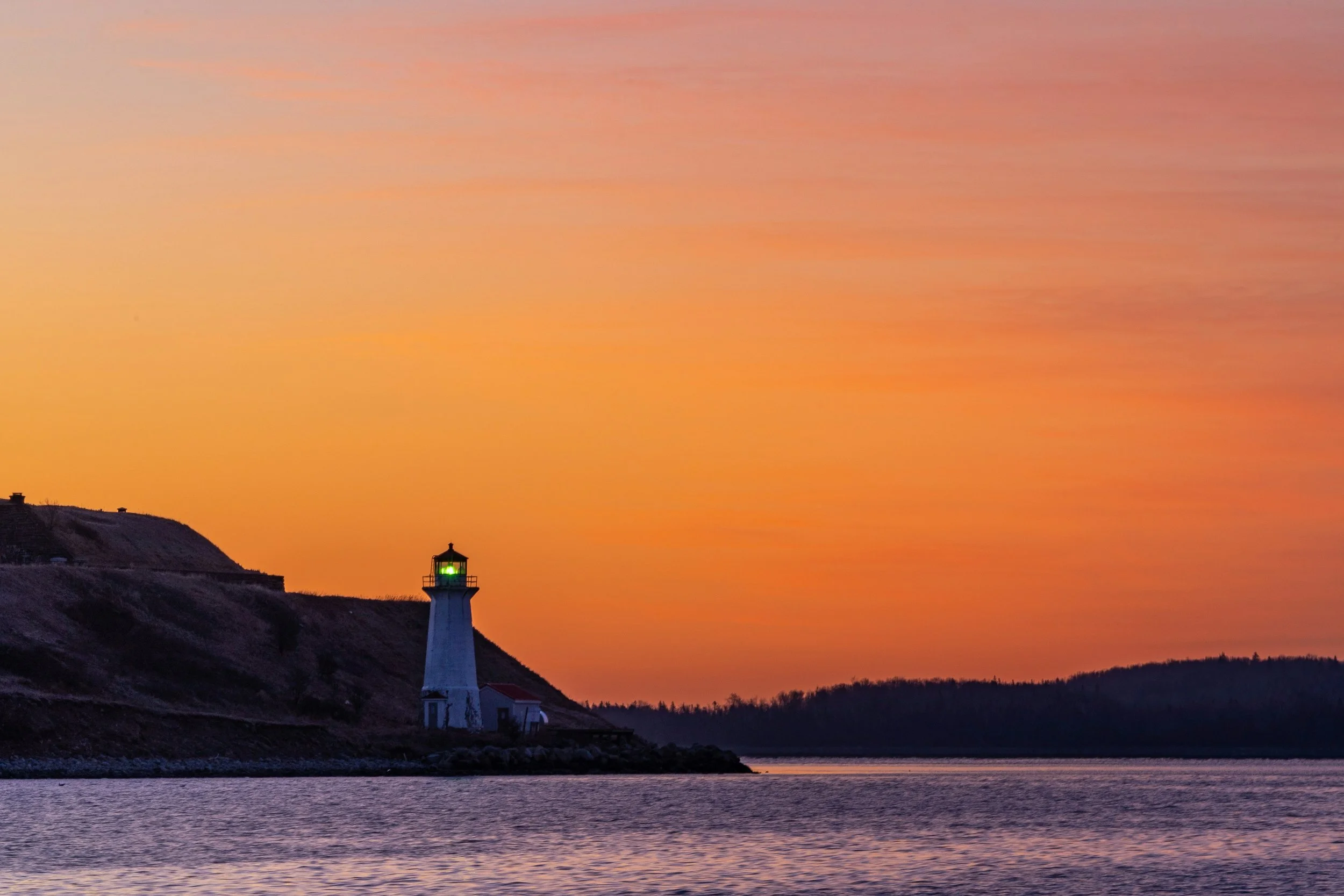
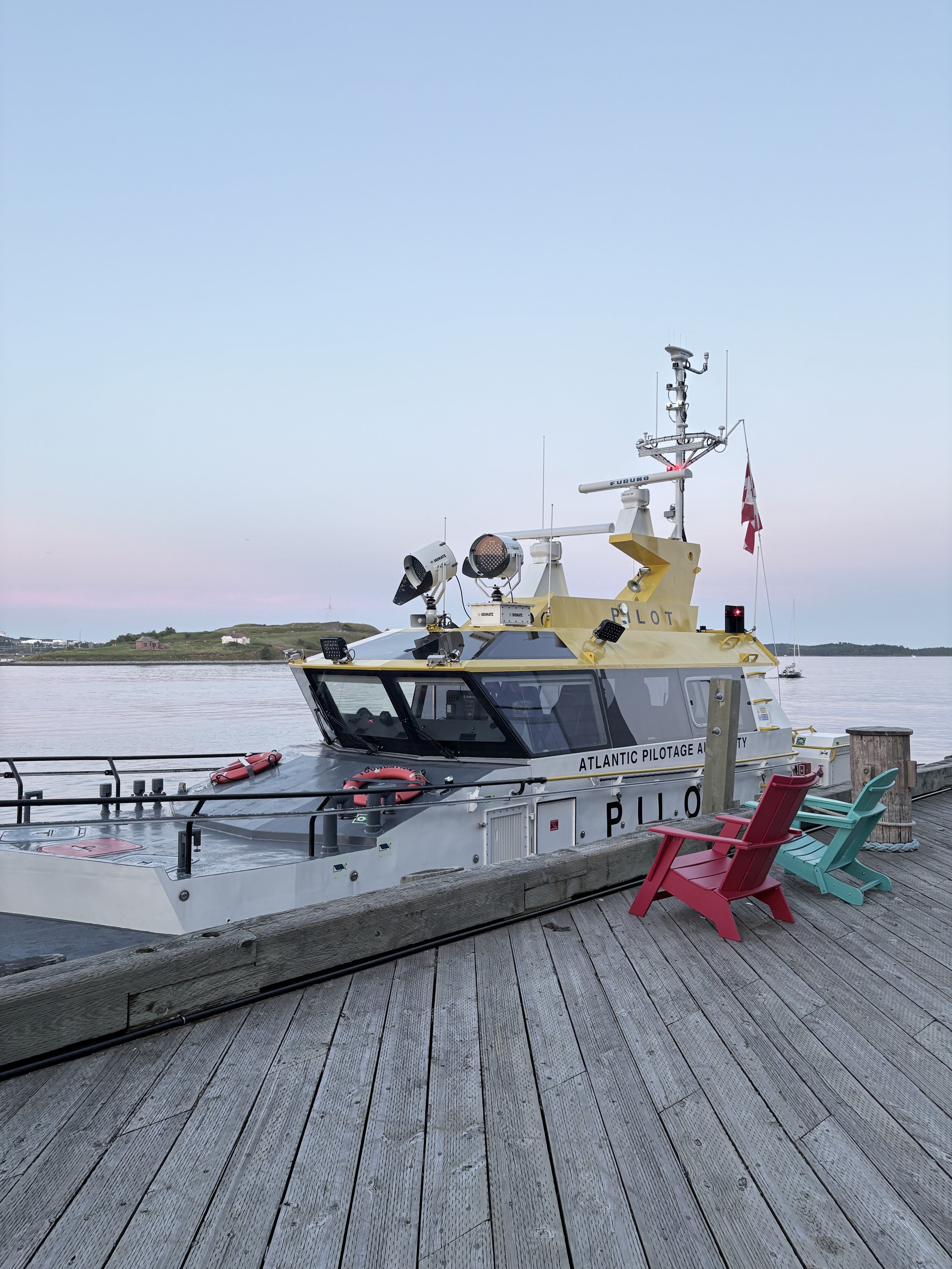
I have a slightly odd obsession. When I'm walking near the water in Halifax, and I spot a yellow pilot boat heading out past Chebucto Head, I stop whatever I'm doing and watch it.
Here's why. That little boat is carrying a marine pilot out to meet an inbound ship. Somewhere out in the approaches, that pilot climbs a rope ladder up the side of a vessel they've never sailed on — sometimes nine metres of ladder, often at night, frequently in fog — steps onto the bridge, and takes over.
The legal term for what happens next is that the pilot has the conduct of the vessel.
Not input. Not advice. The conduct.
I've been turning that phrase over for years now, and it's a useful idea for how we approach regenerative tourism. Let me show you why.
First, the Harbour
Halifax is a compulsory pilotage district. Ships over a certain size don't get to opt out — a local pilot boards, or you don't come in. Sounds extreme until you understand the water (and the weather).
It's about fourteen nautical miles from the pilot boarding station up to Bedford Basin. In between: 74 berths, 13 anchorages, five yacht clubs, a naval base, a shipyard, fishing boats, tour boats, kayakers and the ferries criss-crossing the inner harbour all day long. Then there's the Narrows, where the navigable channel between the fifteen-metre contours is about 175 metres wide, with two suspension bridges overhead at roughly fifty metres of clearance.
Now thread a container ship carrying through that. In fog. Or wind. Or both. With the tide running. At 3 a.m.
The pilots do this 24 hours a day, 365 days a year. They're working to an air gap — water surface to the underside of the bridge — of 1.35 metres in good visibility and 1.55 metres when it's poor. That's roughly the height of a ten-year-old, between a moving skyscraper and a bridge deck. Meanwhile they're holding the underkeel clearance, the windage on that enormous hull, the currents, the tides, and exactly where each tug needs to be in the next ninety seconds.
And when the National Centre of Expertise lists what makes a Halifax pilot successful, the very first thing on the list is local knowledge. Ahead of the training. Ahead of the technology.
My favourite bit of the whole story? Only 180 people have held a Halifax pilot's licence since 1826. This harbour was insisting on proven local expertise before the rest of the shipping world thought to ask.
Now, the Tourism Part
Here's the thing I see constantly in my work, and I suspect you've seen it too. We keep handing over the vessel's conduct to people who've never been in the harbour.
It's almost never malicious. A destination adopts a framework built for somewhere else entirely. A hotel imports a global best-practice playbook, and eighteen months later nobody on the team can tell you what it was actually for. The plan is technically fine and completely unpiloted. It runs aground in the Narrows because whoever drew it up had only ever seen the chart.
The good news is that the research has caught up with what most of us feel in our gut.
Loretta Bellato and Anna Pollock make the case that regenerative tourism only keeps its integrity when it centres place and its communities, drawing on plural place-sourced, Indigenous and other knowledge systems — rather than defaulting to whatever Western academia happens to be publishing. Their conceptual framework with Frantzeskaki and Nygaard lands in the same spot: you're building the capacity of the actual living system in front of you, which, by definition, is not something you can standardize.
Recent work on regenerative entrepreneurship found it from the ground up, too — the enterprises making real progress were the ones taking actions suited to their local context instead of standardized global strategies, because communities hold the knowledge that place-based action runs on.
My favourite piece of evidence? When researchers went looking for what actually drove York's post-pandemic tourism transformation, they found it wasn't a framework at all. It was local knowledge and a strong sense of the city's own identity, feeding capacity building and collaboration — and the people doing it hadn't even labelled it that way. Pride and care go a long way.
Remember, a pilot doesn’t take control of the ship. They take the conduct. They guide. They navigate. However, ultimately, the burden of responsibility falls on the captain. Of course, a business owner is the captain on their ship, and local experts (indigenous or otherwise) are the pilots. The pilot knows the waters, but the captain knows the ship and its crew. When they work together, with the captain deferring to the pilot on matters of local navigation, progress is made, and safe docking can occur.
As a settler and guest in Mi'kma'ki, I hold this alongside Etuaptmumk — Mi'kmaw Elder Albert Marshall's teaching of Two-Eyed Seeing, using the strengths of Indigenous and Western knowledges together. As Elder Albert says: nature has rights, and humans have responsibilities. Not my teachings to carry, but they've changed what expertise means to me.
About that Fog
Halifax fog doesn't ask permission. It rolls in, the city goes quiet, and a ship four football fields long keeps coming.
Sustainability work feels like fog to a lot of the leaders I meet. Regulations shift. The data has holes. The guidance contradicts itself.
Here's the encouraging part: you're never going to get clear weather, but you don't actually need it. What you need is a pilot. Someone who knows this water, who's been here through the storms and the strange years, who can feel the current shift under the hull.
That knowledge already exists in your destination. It's in your community, your residents, your longest-serving guides, in the people who've watched this place for decades, and in the Nations who have known it for millennia.
So, hand over the conduct. I promise it's the best part of the journey.
Sources and Further Reading
National Centre of Expertise on Maritime Pilotage, Halifax Pilots — source for all the pilotage detail above, and genuinely worth an hour of your time.
Bellato, L. & Pollock, A. (2023). Regenerative tourism: a state-of-the-art review. Tourism Geographies, 27(3–4), 558–567.
Bellato, L., Frantzeskaki, N. & Nygaard, C. A. (2023). Regenerative tourism: a conceptual framework leveraging theory and practice. Tourism Geographies, 25(4), 1026–1046.
Bellato, L., Frantzeskaki, N., tebrakunna country and Lee, E., Cheer, J. M. & Peters, A. (2023). Transformative epistemologies for regenerative tourism: towards a decolonial paradigm in science and practice? Journal of Sustainable Tourism.
Bridging sustainable and regenerative tourism through a place-based approach (2026). Journal of Sustainable Tourism.
Framework for regenerative entrepreneurship in tourism: fostering reciprocal relationships within place (2025). Tourism Geographies.
Regenerative tourism development as a response to crisis: harnessing practise-led approaches (2024). Tourism Geographies — the York case study.